What Financial Health Risks do you see when adopting sales growth strategies?

What are the Financial Survival Risks that you see when you adopt a New Strategy of Revenue Growth for your business?

When mentoring executives, especially those involved in turnaround strategies IMPROCUS has found that on occasions the poor performance of the company can be ascribed to insufficient financial understanding by some staff members.  This lack of insight is not so much in how the financial numbers are compiled but is rather found around what implications decisions taken have on the financial health of the company. Weak financial insights inevitably lead to weaker decision making by staff.

It is evident that staff need to understand more of the financial and business outcomes from their decisions on the other areas of the business and not merely how the decisions would affect their function that they are responsible for.

The Siegal Logic-Models™ are uniquely visual aids to enable management to see where the real risks in the business lie and how management affect these through understanding the rules of financial survival.

For example, the business analysis may identify that for the company to become stronger it may need to focus on the growth of existing product sales in new geographical areas not serviced before.  This growth will entail supplying customers further afield than what was the norm in the past.

The focus of the sales team will be to concentrate on getting the sales into that new area.  But what implications does this hold for elsewhere in the business?

Working Capital increases

Many managers do realise that quite obviously, the working capital will be placed under constraints with the increase in debtors and possibly longer business cash conversion cycles will become evident especially if the sales are cross border.

Management might set KPI’s for these changes to ensure that the new strategy works as desired.  Sometimes the KPI’s are tackled in a silo approach, much along the lines of the four-pillar approach to finance.

But what about the other working capital risks that are also affected by this decision?

There are greater risks for the business than the obvious working capital increase that come with such a sales drive.  Often KPI’s are not set for these other areas or linked to each other.

We have come across cases where the production KPI’s do not link to the sales functions KPI’s and it appears as though these functions may be operating in competition to each other.

These risks are more easily highlighted through the Logic-Models™

and because the links can be seen,

entrepreneurs get a better focus for the management team on the overall business improvement process and which other functions are going to be affected by such a strategic initiative.

This model clearly illustrates the links in the process and where the possible other working capital pitfalls may occur, which require management intervention. 

KPI’s for these other risk areas must also be set and monitored along with the sales and debtor’s days measures.  It is important to understand whether the sales are driven from a push perspective or a pull perspective. 

If the business for instance relies on a pull process for its business cycle, how is this being driven into the procurement of its raw resources?  Is the supplier set up for such an increase in volumes and what logistical constraints will be highlighted by the strategy?

Production needs to understand the triggers and drivers here as well as how this affects their resource requirements. 

Procurement will also have to realize what role it must play in the overall working capital game.

How will the resource flows be affected from the suppliers’ perspective with the increased volumes and what will the areas of constraint be that need to be addressed (Goldratt’s theories), even at the suppliers?

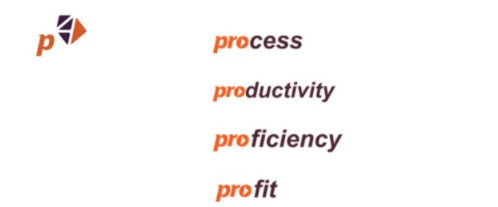
Strategy changes or business improvement focuses require careful analysis of the 4 P’s viz.

This focus needs to be aligned by the management team and there needs to be prioritization that must be implemented to achieve success.

The situation in this high-level example gets far more complicated when one brings in the inherent risks involved with cross border transactions. 

Again, we often find that the finance function places a lot of emphasis in the timing theory of when the ownership risks transfer but ignore the reality aspects of the risks transfer.  For instance, what happens when the paperwork (often completed by people outside of the organization) are not completed correctly.

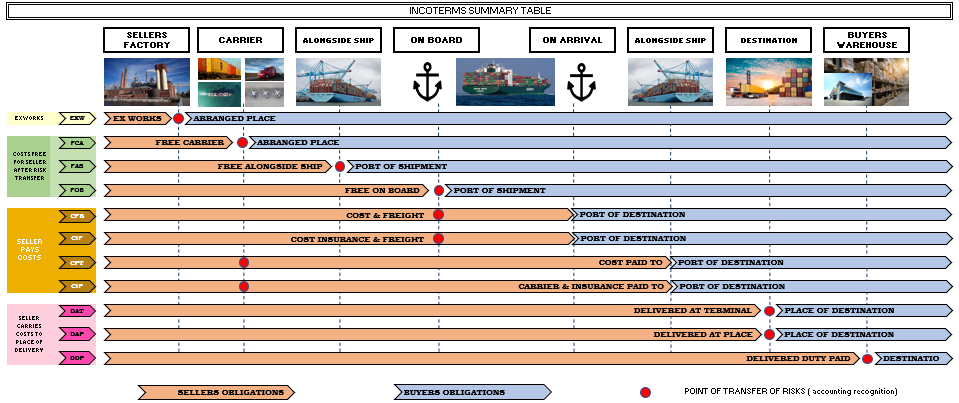
Our table here shows where the Incoterm agreements will transfer the ownership or the risks in the goods administratively, but the real risks involved in such transactions may be far different.

When the goods are sold ex-works and the transfer takes place at the gate of the premises (or upon the transporter taking possession of those goods) the accounting records are easy to write up and identify from the table above and are quickly recorded as such by the finance function.

But if these same goods are now lost along the way to the customers premises, will the insurance pay out for those goods?  What if the border transactions have not been completed properly, will the customer still be able to pay for the goods or will foreign exchange administrative problems delay such payments?  How will such delays affect the rules of financial survival of the business?

How will the company be able to maintain the working capital loss in such circumstances or more directly will it be able to absorb such losses at all? The actual risks are different to the theoretical risks agreed upon for the accounting system reports.

Our experience is that when companies are not performing well, it is this lack of financial insights that is evident from talking with the management team. 

Financial training must go far further than a mere high-level review of how debtor’s days are calculated and what happens to the formulae when sales volumes increase.

We believe that financial insight training goes hand in hand with the proposal of a business improvement solution.