
They invest in assets not resources!
Many of you will now be saying “but all businesses do that when they acquire resources ” .
The fact is that that’s not necessarily true.
A RESOURCE is not always an Asset even though it looks like one and may even feel like one!
Look at these resources acquired for an on line business start-up.

Are they assets?
The accounting paradigm of the definition of an asset is what is clouding many people’s view of what an asset really is and leading them to believe that ALL businesses are investing in assets when they acquire a resource.
However, many are acquiring liabilities!
Let’s start by defining what is an ASSET?
Accountants will define it along these lines (and in my view the accounting language again is showing its limitations here).
In financial accounting, an asset is any resource owned by the business. Anything tangible or intangible that can be owned or controlled to produce value and that is held by a company to produce positive economic value is an asset. … The balance sheet of a firm records the monetary value of the assets owned by that firm. – Wikepedia
So is every resource a company owns an asset?
Business owners and entrepreneurs often seem to forget that the resource must create value! So if it’s creating a liability it can’t be creating value.
What successful companies do is that they invest in or keep the assets that are producing value.
They are also very aware of the FI-SO Principle (highlighted in this Logic Model), and the effect it has on the possible financial success or failure of a business.
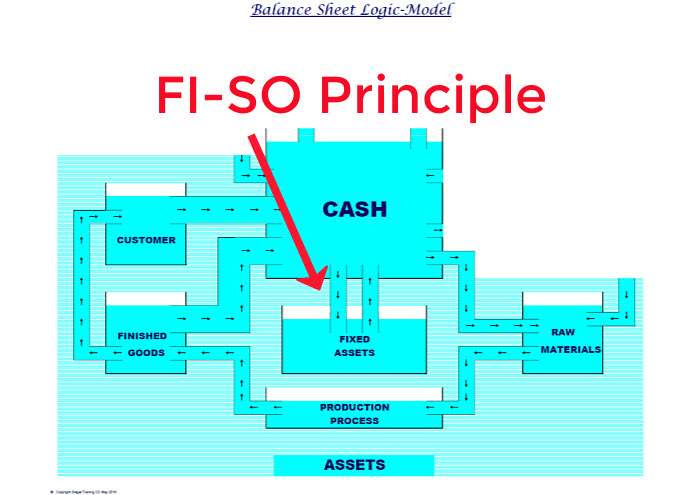
Unsuccessful businesses on the other hand, invest in items that have the characteristics on the outside (or superficially at least) to be creating wealth, but
these resources are actually creating liabilities.
But how can that be?
Let me illustrate what I am saying by way of an example
Setting up an on-line business.
An entrepreneur or a web designer wants to setup an internet shop and they want to sell their services on the net.
What do they do in many of these cases?
More often than not, they go out and purchase the tools of the trade!
These include a new PC (and often they don’t get an ordinary PC either). They take out a data contract with a reputable service provider, for a decent internet line and also go and purchase storage on the web to keep their online data safe. A cell phone contract is a must and is acquired with convenient data bundles (data is cheap we are told).
An entrepreneur or a web designer wants to setup an internet shop and they want to sell their services on the net.
What do they do in many of these cases?
More often than not, they go out and purchase the tools of the trade!
These include a new PC (and often they don’t get an ordinary PC either). They take out a data contract with a reputable service provider, for a decent internet line and also go and purchase storage on the web to keep their online data safe. A cell phone contract is a must and is acquired with convenient data bundles (data is cheap we are told).
Along with the PC they often invest into some software and before they realise it they are $ 5 000 in the hole ! with no sales.
Which is all justified in their minds, because their idea they have is going to make a lot of money in return.
Have they seriously considered the following points:
- Is their idea even going to work?
- Is their service even wanted?
- If it is, are people willing to pay (i.e. part with hard earned cash) for it?
- What is the REAL size of the potential market that they are seeing?
- Are there competitor products out there that are superior and cheaper?
- Have they established yet if their product is being sought at all?
What does the accountant do with this PC equipment, software, etc. that was acquired?
Obviously, he records this “asset” in the books at its historic cost value, of course. Following good accounting convention – so it’s at the lower of cost or net realisable value. He then depreciates this object over its useful life, which let us say is three years.
So what is wrong with this thinking some of you may be asking?
Nothing if you want to stick to the rules of accounting principles of FAIR VALUE of a resource that is called (per the definition) an asset or possession.
However this money that the owner invested in this new resource is not creating any wealth yet ! SO WHY THEN is it being captured as an asset ?
WHAT HAPPENS IF THE BUSINESS DOESN’T TAKE OFF?
Many young entrepreneurs believe they can recoup their costs by selling off the items. Let’s be honest selling second hand PC’s and older software is not going to give you back the money originally invested.
So back to my question at the beginning.
Is This Resource An Asset Or Is It A Potential Liability?
In my humble opinion the cell phone contract is at the very least a liability as it will incur costs for the next two years regardless of what he happens to the business and it should rather be captured as such. Many times the software will be outdated within the year and there will be updates available (for an additional small fee). So it’s an expense at best.
SUCCESSFUL BUSINESSES ONLY INVEST IN THE RESOURCE ONCE THEY KNOW ITS CREATING WEALTH AND WILL RECORD THESE ITEMS AS SUCH UNTIL THEY CREATE WEALTH.
The fact that the tax authorities will see the items with a totally different set of eyes and rules, should not have any bearing on the owner on how the business see these resources.
Are you able to identify these problems easily or are you also “living the dream” of what the resource could possibly become?
( For more on this and how to make a company Survive, Thrive and then Jive visit us at siegalbusinesstraining.com , We will show you how Logic Models and the FI-SO Principle can be utilised in identifying and avoiding these pitfalls in businesses. Learn how to optimise views to those of successful businesses for your venture, whether it be in a new start-ups or in running a well established corporate. )