WHY CHANGE FROM THE FOUR PILLAR APPROACH?
This is the “Financial Insights” training for the businesses in the 21st century (the digital age).
It incorporates business strategy and tactical decision making, with a focus on a forward-looking approach for the business, along with the old training of the four pillars.
Traditional business finance training has concentrated upon giving insights on the historical performance of the four main pillars that underpin business profitability, viz. assets, costs, gearing and tax.
The insights for these pillars however must be built upon a solid understanding of the very foundations of the rules for financial survival, to prevent the business from failing.
Not giving proper attention to this foundation is ignoring the very essence of the business’ future.
The modern CFO or entrepreneur requires an understanding of how daily decisions can weaken these very foundation stones of the business, in addition to how the pillars interact with one another and what characteristics each pillar has in contributing to the financial health of the business.
Armed with these insights they can then add real value to the strategic and tactical directions that they need to take to bolster the foundations and then reduce the risks with each of these four elements, to create value in their business going forward.
IMPROCUS has been historically involved with business turnarounds and profit improvement through focusing on the 4 Ps for the business success.
- Processes
- Productivity
- Proficiencies
- Profitability
In our experience it was often found that businesses failed to unlock their value as the staff did not understand the relationships between these seemingly independent elements.
The staffs’ financial insights often only incorporated the obvious, which was the root cause of their poor performances.
In our experience it was often found that businesses failed to unlock their value as the staff often did not understand the relationships between these seemingly independent elements.
The staffs’ financial insights often only incorporated the obvious, which was the root cause of their poor performances.
For example:
Knowing how the debtors’ days ratio is calculated, is necessary to understand the financial ratios given by most accounting package standard BI reports.
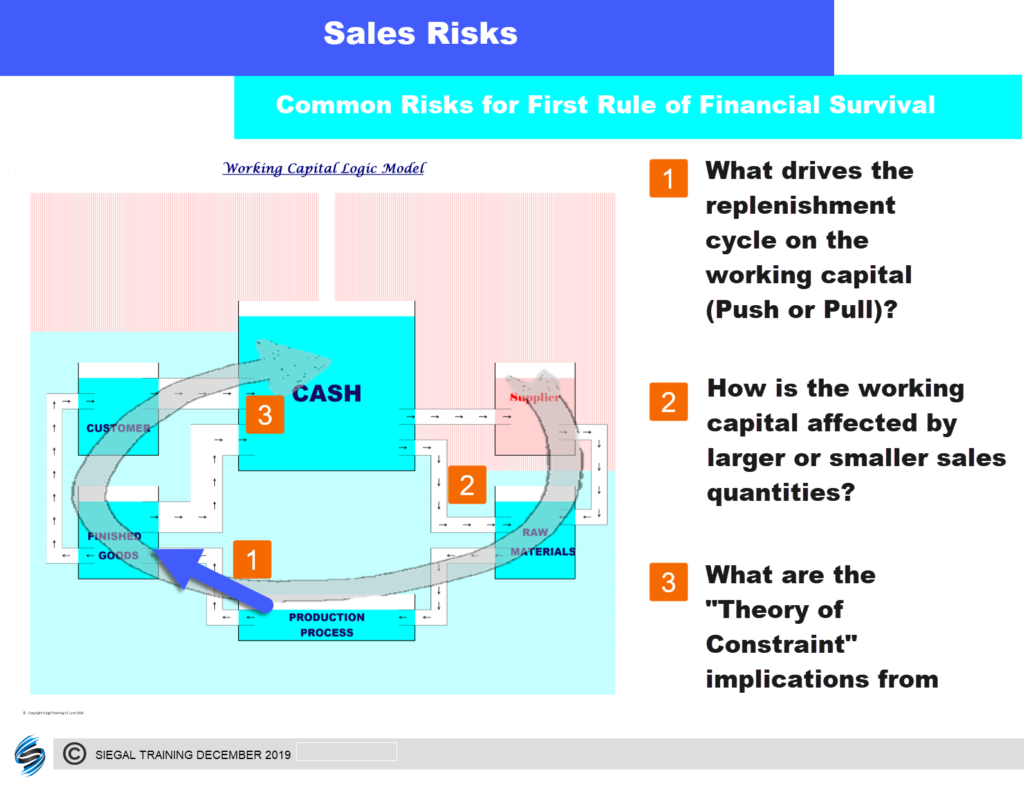
When budgeting for growth it is also important to understand that more debtors require more working capital. To some that is an obvious deduction. However what else does it affect?
Siegal’s Logic-Models™ shows you the inter relationship of how an increase in debtors’ days will lead to a breakdown in resource management and therefore will affect the proficiencies, the productivity and ultimately the profitability of the business.
These are all important risks that need to be managed.
This course gives participants the tools and mind maps to help identify these risks within the foundation stones of the business (the financial rules of survival), and then how to bolster these to ensure that the four pillars (assets, costs, gearing and tax) are maintained and leveraged to get the best results for the business going forward.
Traditional Financial Training did not incorporate these risks.
Traditional financial training, that only concentrated on the historical performance of the four pillars that drove profits historically, is incomplete at the least.
It only gives partial insight to smaller part of the picture required for a startup or how to guide a successful business into the future.
The modern entrepreneur (as well as the CFO) requires more than to know how the elements of the pillars were constructed in the past if they want to have a prosperous future.
The world of 2021 has become more fluid
The landscape of the future business in many cases will have changed, some products will be new and the markets they will operate in futuristically will be very different to those it had encountered in the past.
Companies are starting up more than once these days and the disruptions on the business with lock downs and other interruptions have a bigger affect on the understanding of the theory of constraints.
The modern entrepreneur (and CFO), when making strategic and/or tactical decisions that ultimately will affect how the future business will look in this changing environment, needs to give as much attention to the foundation stones upon which those pillars of finance are based to ensure the future success of that business.